Celebrating solidarity at 25th Annual Salute to Labor
By Sheri Williams
The 25th Annual Salute to Labor Dinner opened with a powerful address from Fabrizio Sasso, Executive Director of the Sacramento Central Labor Council, who reminded the room not only of the Labor Movement’s victories, but of the purpose, resilience and solidarity that make those victories possible.
“Well, here we are. Look at us. We’re surviving, right?” he began, greeting a room filled with union leaders, organizers, elected officials and community partners who together represent more than a century of labor activism in the Sacramento region.
“It’s because of your muscle and your heart, your dedication to this Labor Movement,” he said. “You’ve made the Sacramento Central Labor Council really one of the model labor councils in the entire country.”
The evening marked not only a milestone quarter-century anniversary of the event but also the Council’s 136th year of advancing workers’ rights.
Despite the achievements of the year, Sasso stressed that working people remain under sustained attack, and the chaos of the moment is not accidental.
“Chaos is the strategy of the powerful,” Sasso said. “But in moments like these, there’s only one thing powerful enough to push back—and that’s solidarity.”
He reminded the room that despite political upheaval, economic pressures and threats to collective bargaining, workers have not backed down. Instead, they’ve sparked what he described as a new wave of union activism. People are “waking up because they see the unfairness,” he said, whether in rising costs, excessive executive pay or attacks on workers’ rights across sectors.
Sasso highlighted examples of solidarity across the region—from federal workers and Building Trades members to families facing deportation. These moments, he stressed, prove that solidarity is not symbolic, but relies on action.
“When there is injustice, we will stand. When there is struggle, we will organize. And when there is victory, we celebrate together,” he said.
The evening also honored union leaders for their successes and struggles, including honoring California labor leader David Huerta with the Labor Leader of the Year Award. Huerta is president of the Service Employees International Union California and SEIU-USWW and was arrested over the summer for protesting immigration raids in Los Angeles’ garment district. He continues to face federal charges.
Huerta has long been a powerful voice for some of the state’s most vulnerable laborers. That resolve only intensified following the arrest—a moment that drew national attention and a surge of solidarity from the Labor Movement across the country.
When Huerta stepped out of the federal courthouse after pleading not guilty to a misdemeanor charge tied to the incident, he was met by supporters chanting “Sí se puede!”
Huerta has rejected the accusations of wrongdoing outright, insisting he was present simply because workers were under attack. “I went there because workers are being detained, workers are being criminalized simply because they have the audacity to work and provide for their families,” he said. “When they tackled me, pepper-sprayed me and detained me, what they thought they were going to do was silence me—but I will not be silenced.”
During the award ceremony, Huerta reflected on the roots of his activism.
“People assume that because your last name is Huerta or because you’re brown that somehow you should be deported,” he said. “But I’m a second-generation Chicano raised in southeast LA County, born to a hardworking father who was a Teamster unloading trucks in the City of Commerce.”
Watching his father work taught him the dignity of labor, he said, a lesson that eventually led him into union organizing.
Huerta also reminded the audience that the struggle for equality and fairness is far older than any single political moment, regardless of how bad the Trump administration has been for union workers.
“These attacks didn’t start in June. They didn’t start with Trump. He’s only the latest manifestation of a centuries-long assault on our nation’s workers,” Huerta said, invoking histories of exploited labor across communities.
His message, as always, returned to unity.
“Solidarity means something. Union means something. Standing shoulder to shoulder means something. We will not give in to authoritarians,” he said.
The award recognizes Huerta not just for leadership, but for living the core truth of the labor movement: The fight for justice is generational—and it is far from over.
The Steelman family, longtime members of IBEW Local 340, were also honored at the event with the Legacy Award for their multigenerational dedication to craftsmanship, leadership and the enduring values of union solidarity.
Reflecting on his family’s legacy, Mark Steelman, President of IBEW Local 340, said, “For generations, the Steelman family has been woven into the fabric of Local 340, shaping not just the work we do in the field, but the values, mentorship, and union spirit that guide us today.”
Their story spans decades and reflects a deep belief in the power of organized labor to transform lives and strengthen communities.
The family’s legacy traces back to Allen Clayton Steelman, whose journey into the trade began under extraordinarily difficult circumstances, Mark Steelman told those gathered.
Born around the time of the Great Depression, he traveled from Arkansas to Texas in covered wagons and later rode the rails in search of work. He took any job he could find—from farm labor to field work—and it was while picking lettuce in Montana that he learned of his mother’s passing, a stark reminder of the hardship he endured in those years.
Allen eventually made his way to San Diego, where he worked for a non-union line outfit. A union wireman on the job recognized Allen’s potential and encouraged him to join the IBEW. Allen agreed, and soon after he was organized into the union, an event that changed the trajectory of his family forever. He later moved his family to Sacramento, joining IBEW Local 340 in 1965.
His sons followed closely behind. In 1970, Allen’s son AC joined Local 340, and in 1971, AC’s brother Jim did the same. From there, the Steelman presence in the local only grew stronger.
Today, multiple generations of the family have carried the trade forward, shaping not only the technical excellence of the union’s workforce but also the culture, mentorship and family ethos that define Local 340.
Receiving the Legacy Award honors the Steelmans’ unwavering belief in union values and their profound influence on future generations of electricians, a testament to resilience, commitment, and the enduring power of the IBEW.
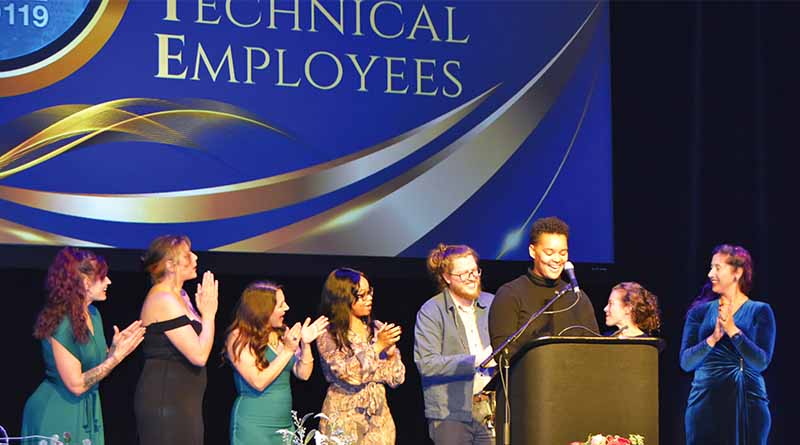
The University Professional and Technical Employees, CWA Local 9119 (UPTE) was also honored with the Fred Ross Excellence in Organizing Award, a recognition reserved for organizations that demonstrate extraordinary commitment, resilience and creativity in building worker power.
The honor comes after one of the most hard-fought, transformative organizing campaigns in the union’s history—a campaign that ended in a landmark contract win for more than 22,000 healthcare, research and technical workers across the University of California system.
Here in the Sacramento region, UPTE represents approximately 3,500 workers at the UC Davis Hospital campus and in the Sacramento County jails. These employees are on the front lines of healthcare, public safety and scientific research, serving one of the largest public institutions in the fourth largest economy in the world.
“That recent contract win came after nearly 18 months of attrition-style, brutal bargaining with UC,” said Amy Fletcher, a UC Davis researcher and statewide treasurer of UPTE. “For months, the University refused to budge, even as hundreds of workers packed bargaining rooms and shared their stories—why their contract mattered for them, for their families, for their patients, and for students.”
Despite the stalling and pressure from the university, UPTE members held firm. Their unity paid off in what would become the largest raises in UPTE history. The new agreement guarantees that every monthly member statewide now earns at least $25 an hour, with the lowest-paid workers receiving even larger equity adjustments and ratification bonuses. UPTE also succeeded in protecting healthcare affordability for thousands of families by preventing dramatic premium increases, winning a floating holiday, improved parental leave and stronger vacation protections to ensure workers can spend meaningful time with loved ones.
In a time of widespread uncertainty within the public sector, the contract also delivered statewide layoff protections, allowing workers to remain in their positions and build sustainable careers.
But the road to that victory began years earlier—at a time when the union itself was struggling, Fletcher said.
“Most of us got involved after the 2019 contract, and even though it was the best contract in UPTE’s history at the time, membership was in free fall,” Fletcher explained. “There was no structure. For a lot of members, the union didn’t even feel like a real thing.”
Fletcher admits she herself crossed picket lines early on because no one had ever explained the purpose or power of the strike to her. That moment of disconnection became a turning point when she met a longtime UC researcher who had worked there for 23 years and had spoken to a union representative just three times.
“That crystallized for me that something had to change,” she said.
And change it did. Following the pandemic—which emptied campuses while flooding hospitals—new leaders stepped up and began rebuilding UPTE from the ground up. Organizers focused on transparency, democracy and listening to members’ lived experiences, she said. They trained new leaders, recruited stewards and created open spaces for workers to say exactly what they needed from their union.
“Instead of assuming we knew what people wanted, we asked them,” Fletcher said. “We asked: ‘What’s important to you in this contract?’ And then the real question: ‘Are you willing to strike for it?’”
That organizing model led to additional local victories, including major safety improvements for workers at the UC Davis Primate Center and Sacramento County jail facilities, where employees had raised concerns for years without action from management.
UPTE’s campaign also averted a massive, system-wide strike that would have included support from more than 60,000 members of AFSCME and the California Nurses Association. Under mounting pressure, UC finally agreed to a deal that UPTE President Dan Russell called “a hard-won victory for 21,000 healthcare, research, and technical professionals across UC.”
For Fletcher, the Fred Ross Award represents something even bigger than the contract.
“It proves to our members—and to ourselves—what’s possible,” she said. “In these dark and uncertain times, we showed that when workers stand together, we can still fight. We can still win. And we can still build a movement strong enough to stand up to even the most powerful employers.”