California Labor leads on artificial intelligence regulation
By Sheri Williams
As artificial intelligence reshapes the American workplace at breakneck speed, the California Labor Movement is demanding that workers be included in crafting common sense regulation.
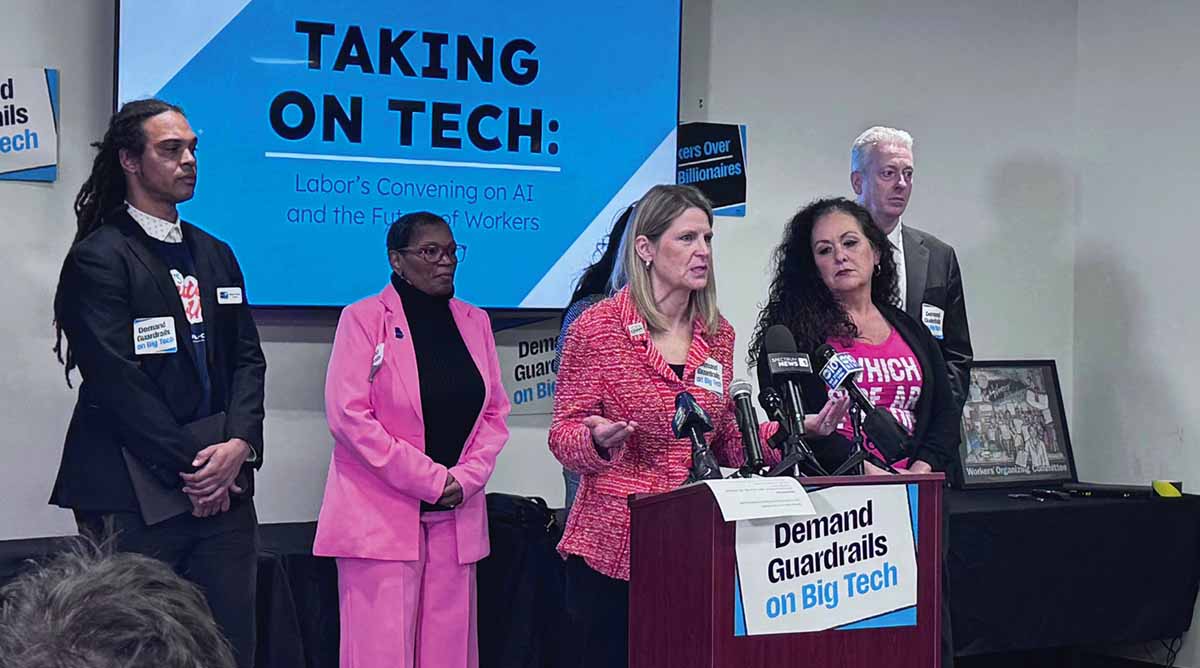
In February, the California Labor Federation made a bold move, inviting Liz Shuler, national president of the AFL-CIO, and union leaders from across the country to Sacramento to kick off an effort demanding that California Governor Gavin Newsom and legislative leaders include working people in crafting guardrails on artificial intelligence. The gathering sent an unmistakable signal: Labor is organized, it is watching, and it will not allow a technology that threatens millions of jobs and even lives to be regulated solely by the technology industry and billionaire investors profiting from it.
Shuler spoke at the event, and framed the moment in stark terms, making clear that labor has no illusions about where help will—or will not—come from at the federal level.
“We have this golden moment before it’s too late to pass AI laws at the state level and to tell these companies: no, you can’t capture and sell our data without our consent. You can’t track our movements without our permission. You can’t experiment on us or fire us on a whim. You can’t use AI to stop our right to organize. You can’t impose technology on us without our input from R&D to the factory floor,” Shuler said.
At the heart of the effort is California Labor Federation President Lorena Gonzalez, who has been direct in her criticism of Newsom’s approach to AI policy. Gonzalez said that the governor has consistently favored big tech companies and billionaires over working people when it comes to shaping the rules around this transformative technology—and that California workers are already paying the price. She is demanding that workers be included in negotiations over new laws, and that the state take a lead role in passing that legislation urgently.
“We don’t want the big tech companies to decide what the guardrails are,” said Gonzalez. “It’s time to step up. It’s not right or left, it’s not Republican or Democrat. It is about people.”
With Congress gridlocked and the federal government unwilling to act, Gonzalez said California has a historic opportunity to set the standard for how AI is regulated in the United States. Union leaders are demanding Newsom seize it—with workers at the table.
The stakes could not be higher. From hotel front desks to hospital exam rooms to the cab of an eighteen-wheeler barreling down the freeway, artificial intelligence is increasingly being deployed not to assist workers, but to plan for their replacement. Truck drivers, hotel clerks, medical professionals and countless others are watching as corporations quietly lay the groundwork to automate their livelihoods, often without any input from the workers themselves or the unions that represent them.
Unions aren’t simply fighting to protect jobs, though. They are raising a broader alarm: just because AI is profitable for corporations and billionaires does not mean it is safe, reliable or ready to operate without human oversight. The technology carries real dangers when deployed in high-stakes environments, Gonzalez and others warned. An AI system making a medical diagnosis or navigating a semi-truck through freeway traffic at seventy miles an hour is not a productivity tool—it is a public safety issue, she said. Workers and their unions understand this better than anyone, and they are demanding a seat at the table before disasters happen.
Shuler was equally clear that regulation is a choice facing elected officials across the country.
“Which side are you on? Working people want common sense guardrails, and they hear promises from politicians all the time saying the right things, saying they’re going to protect workers,” she said.
Shuler made clear that labor is not waiting for Washington to act.
“We are not going to rely on the Trump administration and the big tech CEOs who have been lined up beside him since Inauguration Day. We are not going to rely on a Congress that has never been more partisan and more gridlocked. We are relying on working people and their unions to help chart the path forward—if we get a seat at the table.”
The criticism of Newsom was not limited to California voices. Charlie Wishman, president of the AFL-CIO in Iowa, traveled to Sacramento to deliver some of the most pointed remarks of the day, drawing an uncomfortable comparison for the governor of the nation’s most populous blue state.
“My question for Governor Newsom is: what does success look like when it comes to the development of AI for you? Because your actions—not your platitudes—lead those of us around the nation to deduce that it’s whatever the tech industries and your donors want,” Wishman said. “You have gone so far that you have the exact same stance as my governor back home, Kim Reynolds, on these issues. I think the people of California should probably expect better governance than what we get out of Kim Reynolds in Iowa.”
The comparison landed hard. Newsom has long positioned California as a national leader on progressive policy, yet on AI, labor leaders argue he is indistinguishable from a deep-red Republican governor when it comes to deferring to corporate interests.
Shuler closed the gathering with a direct challenge to the governor and to lawmakers nationwide. “The labor movement and working people across this country are watching, and we demand real leadership,” she said. “Let’s get it done.”