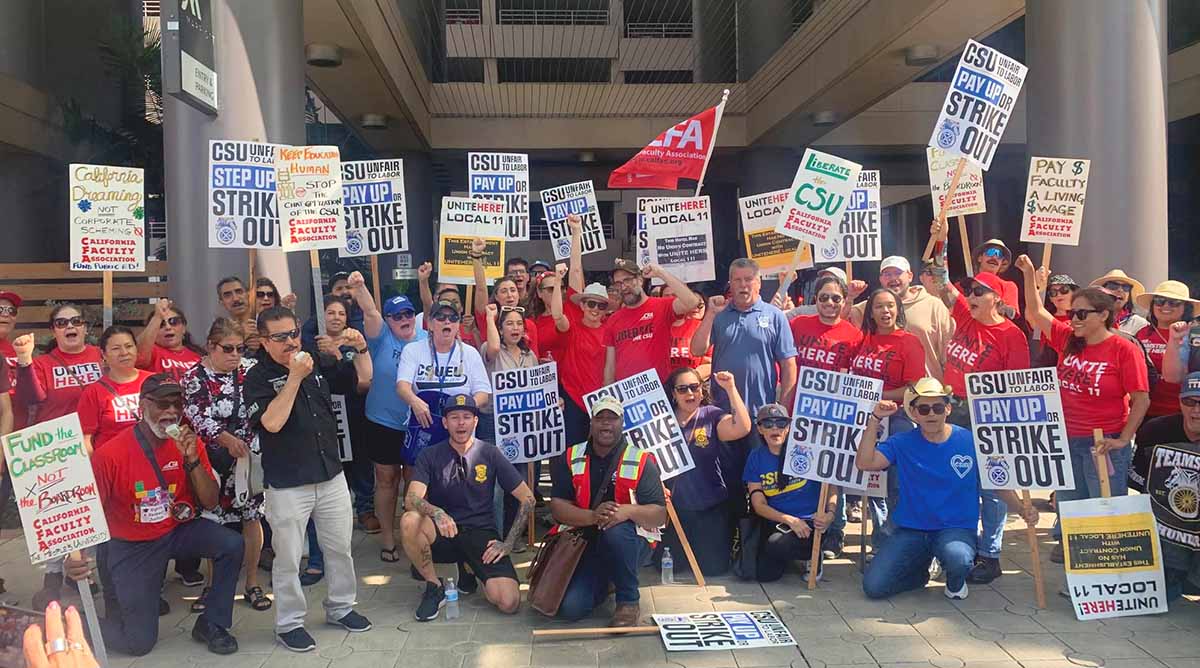
CSU staff fight for fair contract as negotiations drag on
By Sheri Williams
The California State University’s largest union told its members this week that it is not yet asking them to authorize a strike—but that they should be ready in case it does.
The message comes during a summer of union organizing in Sacramento and across the system as union employees from multiple unions fight for new contracts.
In a July 23 bargaining update, the California State University Employees Union said its negotiators have sat down with management six times and that the system has moved on some items but is overall slow and unresponsive. Pay remains a central issue, according to the union, which accused administrators of declining to treat competitive wages as a priority and told members to “take the necessary steps to prepare for a strike authorization vote” if that does not change soon.
CSUEU covers roughly 15,000 employees who keep campuses running—hospital and clinic staff, custodians, office workers, technical and IT personnel—plus 20,000 student assistants and about 1,000 people employed by campus auxiliary organizations. That makes it the biggest bargaining unit in the system. Its staff agreement lapsed June 30 after four years. The student assistants and auxiliary employees have never had a contract at all; they are negotiating their first.
The union’s opening show of force came on the day that agreement ran out. At Sacramento State, more than 20 employees looped the campus library quad chanting for a fair contract, one of 13 campuses where members marched, rallied, made signs and hand-delivered letters urging campus presidents to press the Chancellor’s Office on their behalf. Demonstrators carried placards reading “Ready to Strike,” “When We Fight, We Win” and “Higher Ed Not Lower Pay.”
A union news release framed the day as a signal to administrators that this round of bargaining would not resemble earlier ones. CSUEU has never gone on strike. A walkout could shut down the largest public university system in the country.
The union’s economic proposal calls for 11% raises in each of three years, and CSUEU says the CSU has yet to counter it. The union also wants the step system—automatic raises tied to years of service within a job classification—funded and put into practice. Steps, it argues, undo accumulated pay inequities, let employees know in advance what their anniversary raise will be, and give staff a reason to build a career in one place rather than leave. Employees who have topped out on their scales, known as red-circled workers, would receive longevity increases under the proposal.
That frustration over compensation extends well beyond the staff unit. Megan O’Donnell, a faculty member at CSU Monterey Bay and a member-at-large of the Academic Senate CSU executive committee, told trustees during public comment at its recent meeting that the system’s rhetoric about recruitment does not match what its negotiators put on the table.
“Repeatedly, we hear that the CSU wants to be an employer of choice. That competitive compensation and excellent health benefits are essential to not only recruiting your faculty and staff, but maintaining the top tier of workers that make it possible for the CSU to lead,” O’Donnell said. “Yet the bargaining team for the chancellor’s office has continued to provide uncompetitive, lowball offers for compensation, compensation that doesn’t come anywhere close to matching what is urgently required to ensure that CSU employees can live and work where we need to be.”
Job security occupies equal space in CSUEU’s platform. The union contends the system leans on long-term temporary, part-time and intermittent appointments, farms out bargaining-unit work to non-union firms that pay less and offer weaker benefits, and is introducing artificial intelligence in ways that chip away at job protections. It is demanding a guaranteed voice in decisions about how work is organized and automated.
The union has also said management proposed stripping its members’ right to strike, and has characterized the CSU’s conduct at the table as disrespectful.
O’Donnell, addressing the board directly, asked trustees to intervene in their own negotiators’ approach. “I ask all of you to provide greater oversight and greater leadership in pushing your bargaining team to negotiate fair contracts with your employees,” she said, before closing with a line that has become a rallying cry across the system this summer: “It is time to support the people who make the CSU work. It is time to fund the classroom, not the boardroom.”
Faculty are further down the same road than staff. The California Faculty Association—29,000 instructors, librarians, counselors and coaches—declared impasse, and the Public Employment Relations Board upheld that declaration over management’s objection. The two sides have entered mediation, in which a state-appointed mediator generally shuttles between the parties rather than seating them together. Should mediation fail, the process advances to factfinding, the final statutory stop before faculty could legally walk out. CFA members have picketed a Board of Trustees meeting under the slogan #FundTheClassroomNotTheBoardroom, pressing for a faculty role in university decision-making and for stronger protections against discrimination on campus.
Teamsters Local 2010, representing about 1,100 skilled trades workers, saw its agreement expire on the same June 30 date. With CFA’s repeatedly extended contract also lapsed, virtually no CSU labor unit is currently working under one.
Now that the state budget is signed, CSUEU has said it expects negotiations to move without further delay. More campus demonstrations are planned through the summer, with students due back on campus in a matter of weeks.