State workers continue push for remote work
By Lila Swanson
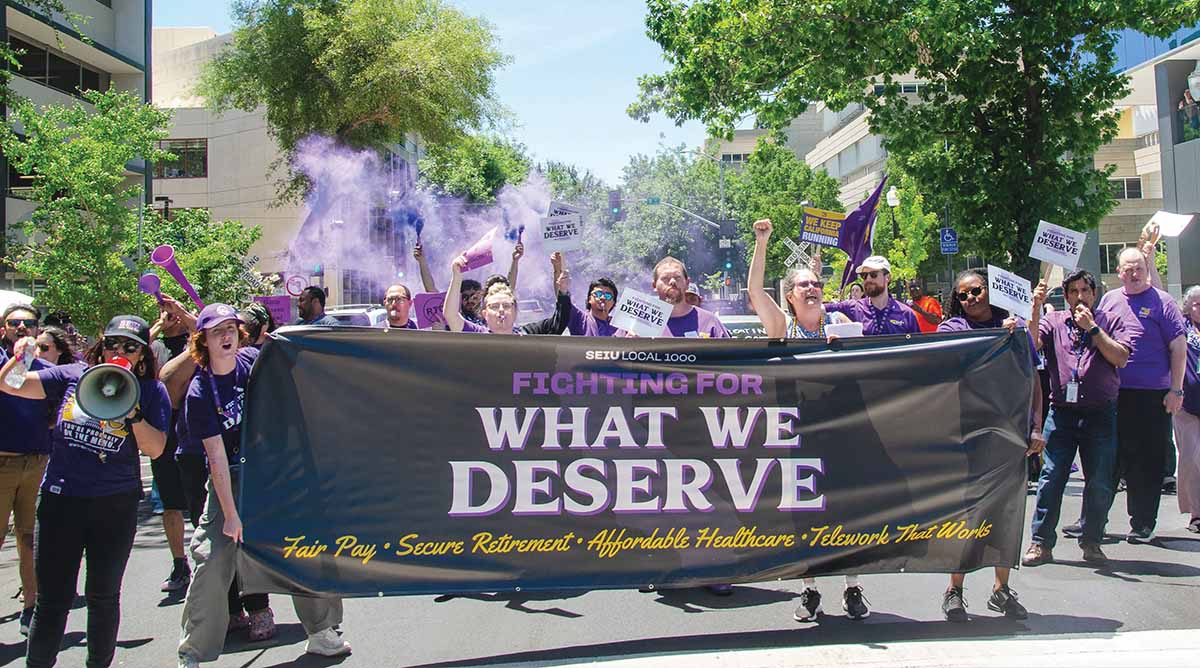
SEIU 1000, which represents thousands of state workers, is continuing to fight for telework rights even as its members were ordered back into downtown offices this month.
In late June, the union staged a rolling car protest through Sacramento. Drivers leaned on horns and brought noisemakers and whistles, filling the blocks around state office towers with a racket that was hard to ignore. It was the latest effort to draw attention to the years-long issue between the governor and union workers who have successfully worked remotely since the pandemic.
The push to return now, “doesn’t make too much sense,” said Anica Walls, president of SEIU 1000 in a media interview. “So it’s frustrating.”
Walls pointed out that one study showed remote work has allowed the state to save up to $250 million dollars.
“It doesn’t make sense that we’re being pulled back physically into an office when we’ve proven that we can modernize how we do our jobs, do it hybridly, and do it efficiently, and save the taxpayers money,” she said.
Gov. Gavin Newsom’s executive order from early 2025 directs most state employees to show up in person at least four days a week, leaving room for just a single day of remote work. A number of unions, SEIU Local 1000 among them, dropped their lawsuits last year after winning a one-year postponement of the order for their members. That postponement expired at the start of July and workers were expected to return to in-person assignments, though the union continued to push on the issue as of the time of publication.
The protest caravan grabbed attention, but the more consequential battle is playing out in negotiations. The union’s labor agreement lapsed at the end of June, and remote work is just one of several demands its bargainers are advancing as they seek a new deal. Protections under the old contract stay in effect until both sides sign a replacement, and the union has made clear it would rather keep negotiating past the deadline than settle for an agreement it views as falling short.
“We are in the fight for a strong 2026 contract,” said Walls, who counted fair pay, a secure retirement, affordable health care, and “telework that works” among the union’s aims. She called on members to stand together and refuse to let the state weaken their determination.
The union is pressing on several fronts simultaneously. In mid-May it lodged an unfair labor practice charge with the Public Employment Relations Board over the in-office mandate. That complaint has since moved past an initial screening, with the board moving the matter forward toward an informal mediation session. Because these proceedings unfold slowly, the filing won’t halt the July transition.
Alongside the legal track, the union has thrown its weight behind AB 1729, a telework measure making its way through the Legislature with help from allied groups.
The union’s position on telework drew notable backing in August 2025, when the California State Auditor warned that applying a single uniform telework rule across every agency conflicts with state policy and risks throwing away substantial savings.
Reviewers calculated that 19 departments laid out close to $117 million in the 2024–25 fiscal year for roughly 3.2 million square feet of workspace that frequently went unoccupied. If employees were allowed to work remotely three or more days weekly, the state could trim its real estate by about a third, the audit found, yielding yearly savings approaching $225 million.
Auditors further noted that the Governor’s Office skipped over crucial data on space requirements and expenses before handing down its directives. When employees were surveyed, more than four in five objected even to the milder two-day rule, and close to half of departments said the in-office push had made hiring and keeping staff more difficult.