Teachers lead fight against AI replacements
By Sheri Williams
As artificial intelligence pushes deeper into California schools, the state’s teachers are drawing a line: a person, not a program, must do the teaching.
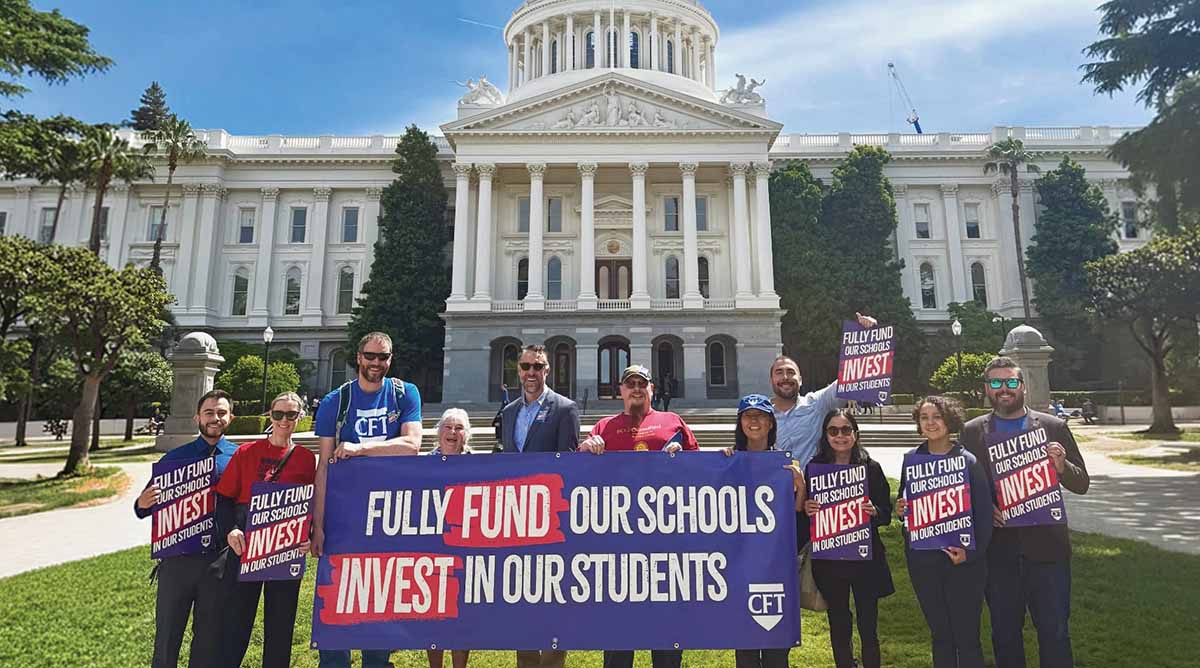
Assembly Bill 2148, a bipartisan measure carried by Assemblymembers Al Muratsuchi, a Democrat, and Josh Hoover, a Republican, would prohibit artificial intelligence from standing in for human educators in public schools. Championed by the California Federation of Teachers, the bill cleared the Assembly 76-0 in early May and passed the Senate 38-0 on June 18. It was sent to Gov. Gavin Newsom on June 24, leaving its fate to his desk.
At its core, the bill rests on a single, foundational idea: a public-school employee, or a contractor providing services in a school, must be an actual human. The protected roles are spelled out broadly, covering teachers, classified staff, counselors, nurses, psychologists and social workers.
Muratsuchi has framed the measure as protecting educators’ autonomy and ensuring that technology serves teachers rather than replacing or penalizing them. The union’s argument leans on what machines cannot replicate: judgment, mentorship and the trust built between an adult and a child over a school year. Supporters said the bill is a starting point rather than a finished framework, and CFT has signaled it wants further “guardrails” that guarantee teachers, not algorithms, decide how lessons are taught. The California School Employees Association co-sponsored the bill, and the California Teachers Association and the California Federation of Labor Unions added their backing.
AB 2148 is part of a wider wave of organized labor pressing to shield workers from automation. The same anxiety driving teachers also animates campaigns across the service and tech sectors, where unions warn that AI could hollow out jobs faster than safety nets can be built. California lawmakers have repeatedly tested measures to require disclosure when employers use automated systems to hire or discipline workers, and the issue is far from settled even after past vetoes.
The state’s executive branch has moved on a parallel track. On May 21, Gov. Newsom signed what his office called a first-of-its-kind executive order to prepare workers and businesses for potential AI disruption, paired with a first-in-the-nation online tool to monitor and detect AI-related job loss. The order directs state labor agencies to build a framework for responding to workforce upheaval, exploring ideas such as retraining resources, transition support, and worker-ownership models so that employees share in the productivity gains AI creates rather than simply absorbing its costs. It builds on an earlier order this year that tightened privacy and civil-rights standards around the state’s own use of AI.
Together, the bill and the order reflect how quickly the politics of AI have shifted from abstract to urgent. AB 2148 is only one thread in a dense legislative season: roughly thirty AI bills advanced past this session’s crossover deadline, touching chatbot safety, student data privacy, copyright, and health care.