California Labor fights against corporate monopolies
By Sheri Williams
As Californians grapple with what labor leaders and consumer advocates call the worst affordability crisis in the state’s history, a growing coalition of unions, small business owners and antitrust experts is pushing state lawmakers to rein in the corporate consolidation they say is driving up the cost of groceries, housing, health care and utilities.
“This is about big tech wielding their power in California—not just to get wealthier, and not just to squeeze the little guy, but also to control our elections. This is about democracy,” California Federation of Labor Unions President Lorena Gonzalez said at a recent rally, arguing that corporate consolidation is fueling both economic inequality and outsized political influence. She invoked the trust-busting era of more than a century ago, telling the crowd that unlike then, “there are no Teddy Roosevelts that are coming to save us. So we need to save ourselves.”
In one of the toughest legislative fights this year, the California Federation of Labor advanced Assembly Bill 1776, the COMPETE Act, to fight that corporate power. The bill would give the state new tools to challenge a single dominant corporation that uses its market power to raise prices, suppress wages, or block workers from organizing—conduct current law struggles to reach because it was written to target coordinated action between multiple companies, not a single firm acting alone.
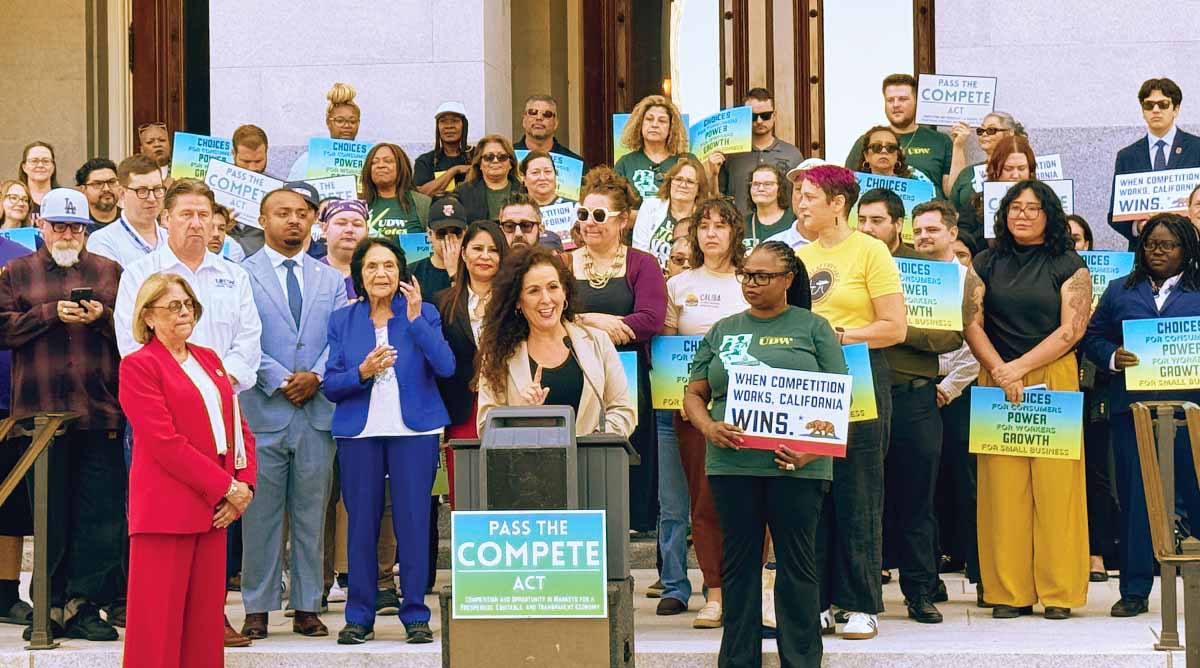
At the time of publication, the bill was advancing, but faced intense opposition from business interests. Supporters rallied at the Capitol to raise awareness of the bill in August. Gonzalez joined Assembly Majority Leader Cecilia Aguiar-Curry (D-Davis) to urge the state Senate to pass the bill.
Longtime labor and civil rights leader Dolores Huerta, co-founder of the United Farm Workers, also addressed the rally, sharing her family’s history to underscore the stakes for small business owners. Huerta recounted how her mother, a single parent raising three children, opened a small restaurant because it was the only way she could support her family and eventually send her kids to college. “All of those small entrepreneurs out there, all of those small businesses out there, they are a vital part of our economy,” Huerta told the crowd, urging lawmakers toward a “sí se puede”—yes, we can—vote on AB 1776.
Aguiar-Curry, the bill’s author, said the legislation is designed to restore fair competition to markets that have grown increasingly concentrated.
“When there’s less competition, prices go up and people pay more for goods and services,” she said. “The COMPETE Act updates our antitrust laws so businesses can compete fairly, ideas can succeed, and Californians aren’t stuck with higher prices and fewer options.”
Mark Ramos, president of the Western States Council and UFCW Local 1428, described how consolidation has reshaped the grocery industry over his nearly four decades in the business. He recalled that when he bought a home in Southern California in 1999, the region had more than a dozen union grocery stores; today there are just three.
“When too much power is in too few hands, workers lose bargaining power, consumers lose choices, and small businesses struggle to compete,” Ramos said.
The COMPETE Act would modernize the Cartwright Act, California’s century-old antitrust law, by codifying recommendations from the California Law Revision Commission (CLRC), an independent state agency the Legislature tasked in 2022 with reviewing the state’s antitrust framework. Central to the bill is a “single firm conduct” standard, which would give regulators and private parties new tools to challenge anticompetitive behavior by a single dominant company—closing what supporters describe as a major gap in current law, which primarily targets coordinated conduct between multiple companies.
Supporters say the standard is especially urgent in healthcare and labor markets, where consolidation of hospital systems and provider groups has been linked to higher costs and worse patient outcomes, as well as growing employer power over wages, staffing levels and workers’ ability to organize. Backers argue that without updated antitrust tools, dominant hospital systems can raise prices, cut patient services or pressure public providers to absorb costly Medi-Cal and Medicare patients without legal recourse.
If passed, AB 1776 would align California with 45 other states that already apply a single-firm conduct standard under their antitrust laws. Supporters are urging the Senate to bring the bill to a vote before the end of the legislative session.