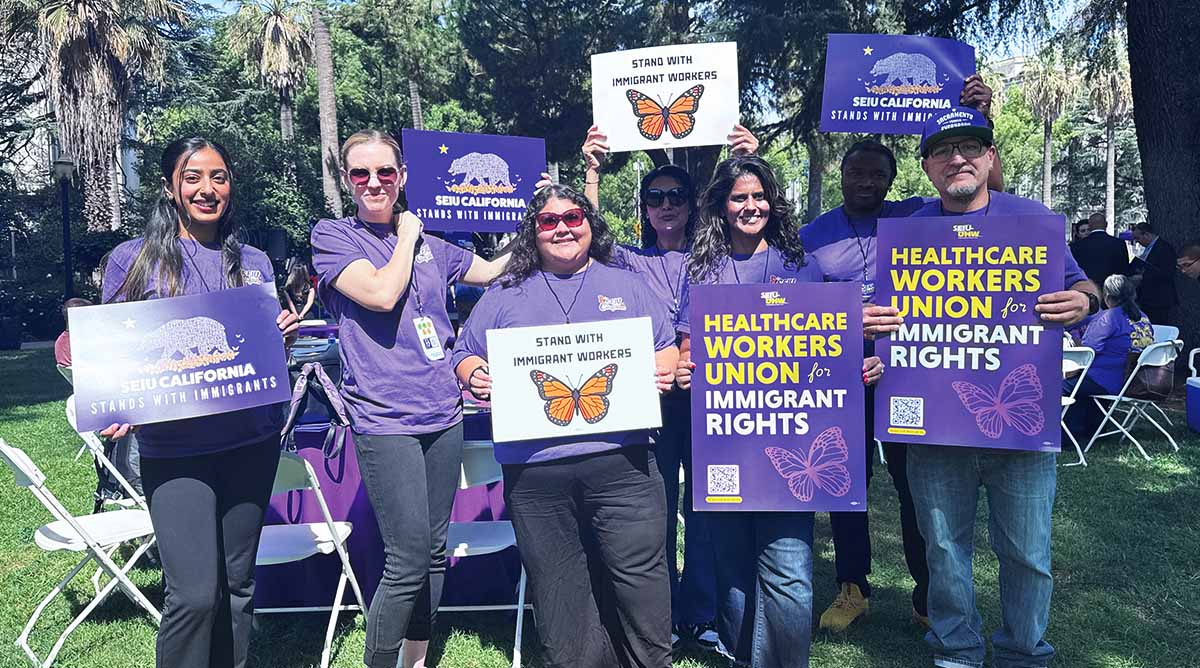
SEIU members rally for immigrant protections
By Lila Swanson
As federal immigration crackdowns continue to target working people in California, SEIU members rallied at the state Capitol to raise awareness and help pass legislation to protect families.
The message from union members was urgent and unified: As ICE and CBP activity spreads fear through California communities, the Legislature must help provide safety and rights for immigrant workers, children and communities.
The rally, organized by SEIU California, brought together healthcare workers, child care providers, and other union members alongside Assemblymembers Isaac Bryan, José Luis Solache, Juan Carrillo and others. Many of the SEIU members who gathered on the Capitol steps are themselves immigrants or come from mixed-status families, meaning the policies under debate aren’t abstract to them—they describe living with the same fear as the families they serve, at home and on the job.
That lived experience was central to the remarks of Ana Valentino, a family child care provider and member of SEIU Local 99, who addressed the crowd in Spanish. Valentino said her home is meant to be a place where children learn, play, and grow—not a source of fear—but that many of the families she serves are now living with the constant worry that a mother, father, or loved one could be detained and taken from them.
“In moments like this we need, more than ever, adults we can trust and places where we can feel safe,” she said. “As a child care provider, I also need to see what my rights are and how I should act if immigration agents come to my home while I have children in my care.”
Valentino said she sees that the children absorb the fear, too.
Organizers said the stakes extend well beyond the Capitol steps. Over the past year, they said, indiscriminate stops, racial profiling, and family separations have rippled outward into classrooms, workplaces, and neighborhoods across California. With just weeks left in session at the time of the rally, SEIU members said the Legislature has a limited opportunity to respond.
Organizers used the event to spotlight four bills they said are essential to protecting immigrant communities: AB 1655, which would preserve CalWORKs eligibility for families when a child is detained by immigration authorities; AB 1896, which would bar former immigration enforcement officers from public employment in California; AB 2379, which would require training and resources for family child care providers on how to respond to enforcement actions; and SB 1004, which would require federal officers to identify themselves and ban face coverings during enforcement operations. As of publication, all four bills were advancing, but had only days to pass.
Valentino closed her remarks by urging the crowd to lobby lawmakers in support of AB 2379, the bill she said would replace uncertainty with the knowledge and preparation that child care providers like her need.
Assemblymember Bryan, author of AB 1655, argued that in ordinary times a law like his wouldn’t be necessary—but said the current moment demands proactive steps to shield children from being pushed further into hardship because of a parent’s detention.
Solache, a co-author of AB 2379, said the bill is designed to arm child care workers and families with concrete legal tools for encounters with enforcement officers, protecting both workers and the children in their care.
Carrillo used his remarks to condemn conditions at the Adelanto ICE Processing Center in his district, citing reports of contaminated water, inadequate food, and limited medical access. He argued that dignity is not conditional on citizenship or immigration status, and that silence in the face of documented mistreatment only allows it to continue.
Guillermo Mendoza-Lujan, an ER nurse and member of SEIU 121RN, connected the fight to broader questions of equity and shared humanity, arguing that immigrant communities deserve the same respect and protection as anyone else.
The rally also featured a Danza Azteca performance honoring Indigenous tradition, and members built an ofrenda to commemorate lives lost in ICE and CBP custody.