Nurses win court order stopping voter intimidation
By Sheri Williams
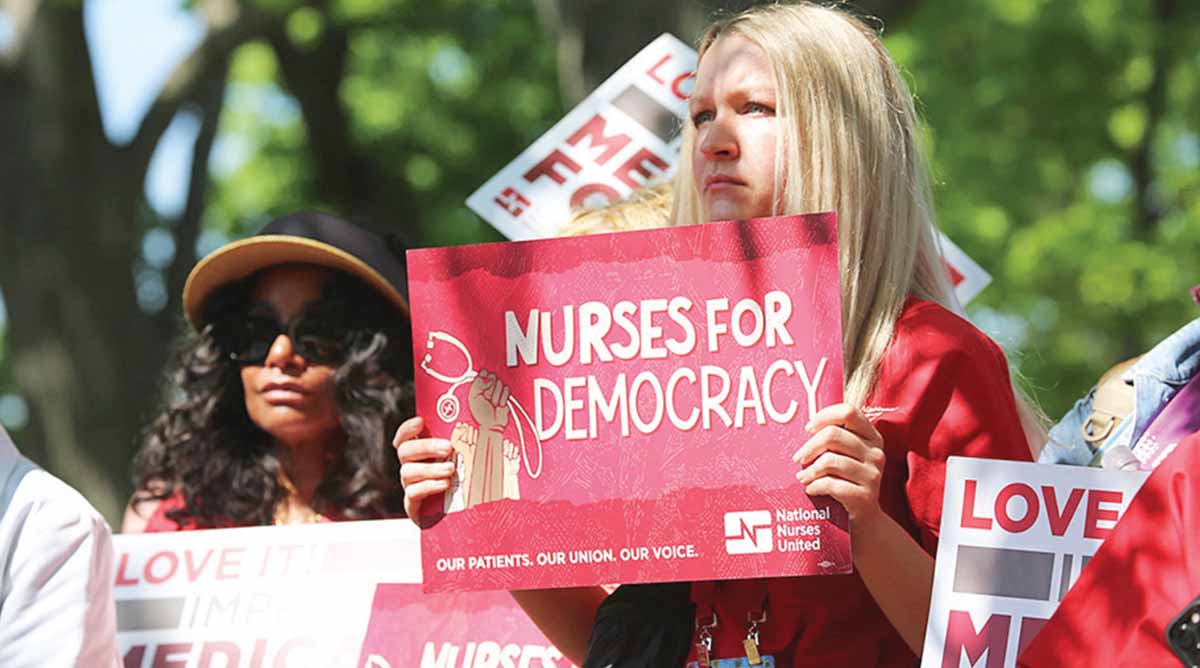
A coalition led by the nation’s largest union of registered nurses won a federal court order in October blocking armed Department of Homeland Security agents from showing up at Americans’ doors to question whether they are eligible to vote.
U.S. District Judge Araceli Martínez-Olguín granted a preliminary injunction on Oct. 21 in California Nurses Association v. Mullin, less than two weeks before the Nov. 3 midterm elections. The order covers California, Connecticut, Georgia, Missouri, Nevada, New York, Pennsylvania, Washington and Wisconsin.
For the nurses who brought the case, the win was about protecting not just members, but free and fair elections.
“So many people in the United States are suffering under Trump’s corrupt and cruel policies on behalf of the billionaire class that he knows cannot hold onto power in these upcoming elections without illegally suppressing our vote through outright harassment, intimidation, and even detention,” Puneet Maharaj, executive director of NNU and CNA, said in a union statement.
“But nurses fight for our patients and for our vision of a healthy society, and that all starts with fighting for a healthy democracy,” Maharaj said. “As nurses, we respect and uphold the human dignity of each person. That translates into the right of each person to have a voice and a vote in decisions that determine the conditions of their life.”
Maharaj pointed out that CNA and its national umbrella, National Nurses United (NNU), represent more than 225,000 registered nurses nationwide. CNA alone, founded in 1903 and based in Oakland, counts more than 105,000 members at over 200 California hospitals and facilities, according to the unions’ complaint—including in Sacramento. Their ranks include many immigrants and naturalized citizens, along with nurses whose households include family members with differing immigration statuses.
The union argued in court that those members are especially hurt by the DHS investigations, and some members have decided not to participate in union election activities this year out of fear of government retribution. That, the union said, posed a direct harm to their core mission of organizing for workers’ power.
One union member cited in the case, a naturalized citizen who works as an acute care nurse in the San Francisco Bay Area, said she worried agents would come for her by mistake despite her citizenship, or pick her out precisely because she was naturalized. Although she wanted to cast her ballot in person, she switched to voting by mail and decided to stay away from campaign events.
Other nurses pulled back as well. One quit going to events for a candidate they supported. Another gave up plans to volunteer as a poll monitor this year.
The judge called such fears “objectively reasonable” and “well understood as intimidation.”
In the end, it was the nurses who carried the case. The judge ruled that only CNA and NNU had shown the legal standing needed for an injunction at this stage, while the two local governments and Voto Latino, a nonprofit involved in the legal filings, had not. She wrote that protecting voting rights and helping voters is plainly central to the unions’ mission.
The injunction bars DHS from election-related field interviews and other field operations aimed at people the government knows, suspects or reasonably should suspect are U.S. citizens. It also limits operations that rest solely on records produced by the department’s voter-matching effort, which DHS named the “Unlawful Voter Initiative.”
DHS built its target lists by matching tens of millions of records, some drawn from commercial data brokers, largely on names and birth dates. But those lists, the union argued, have been riddled with errors and found to include legal voters in multiple instances. The judge found a “high likelihood of error” in her review, noting that no federal database tracks the citizenship of every U.S. resident.
Martínez-Olguín found it is DHS policy to single out naturalized citizens whenever its data hints they voted before becoming citizens. The department itself conceded in court that its matching can go wrong because of look-alike names, missing records and outdated citizenship information.
Beau Tremitiere, a Protect Democracy attorney on the case, said the decision confirmed that citizens, “whether born here or naturalized,” have the right to vote free from harassment by armed agents.
Martínez-Olguín concluded the nurses are likely to prove the program violates the Voting Rights Act, which forbids intimidating people who help others register and vote. She cited evidence of a “reasonable fear of harm to those assisting and mobilizing voters,” the San Francisco Chronicle reported.
The ruling leaves DHS free to pursue voter fraud through other lawful means. It stays in force until voting ends on Nov. 3. As the Bulletin went to print, the government was appealing the ruling.
The nurses were joined in court by the Voto Latino Foundation, the City and County of San Francisco and Santa Clara County. Protect Democracy and the National Immigration Law Center served as co-counsel alongside local government attorneys.
Armed with the win, the union is urging members not to be deterred from participating in elections.
“It’s no surprise that Trump is ramping up the use of his paramilitary forces leading up to the election,” CNA said. “He wants to intimidate voters, but it won’t work. Our voices will not be silenced: VOTE on or before Nov. 3!”