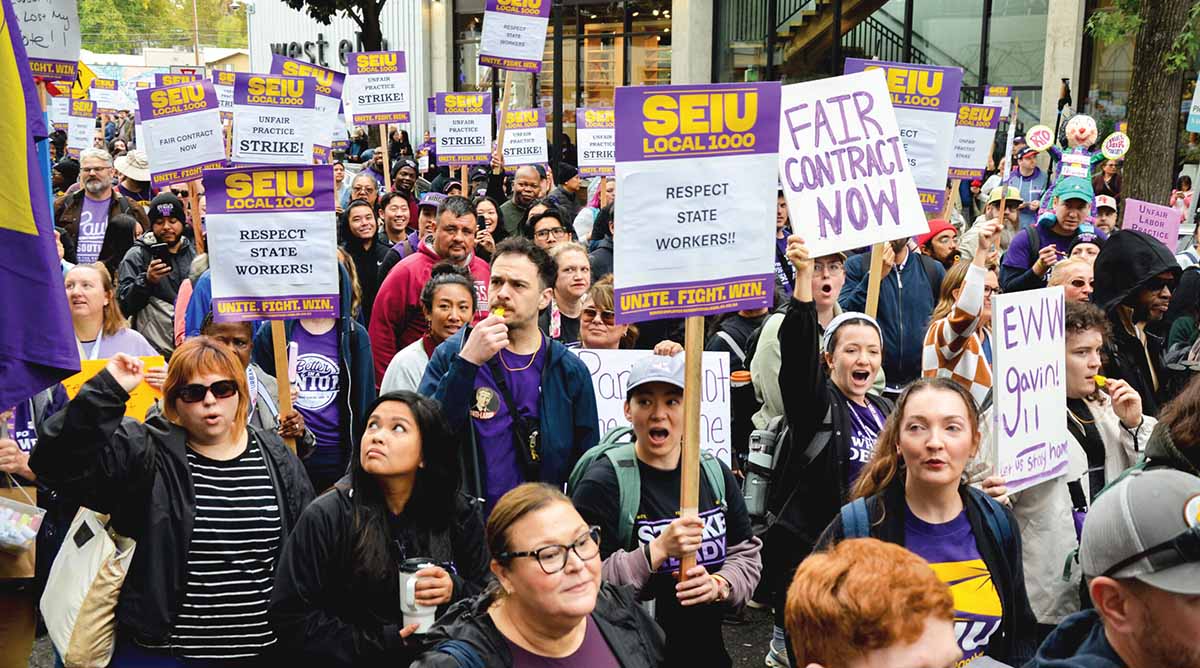
State workers make history with first-ever strike
By Lila Swanson
Thousands of California state workers walked off the job Wednesday, Oct. 21, in the first strike in the 44-year history of SEIU Local 1000, the largest union in state government.
Dressed in trademark union purple, strikers rallied outside the California Department of Human Resources in downtown Sacramento before marching toward the State Capitol.
“We didn’t choose this fight, but we’re definitely not backing down from it,” Local 1000 President Anica Walls told the crowd.
The one-day Unfair Practice Strike also put picket lines in front of state buildings in Oakland, San Francisco, Fresno, Los Angeles, Norwalk, San Bernardino and San Diego. Its goal was to push the Newsom Administration back to the bargaining table to negotiate in good faith after months of unsuccessful talks.
Local 1000 represents roughly 100,000 workers, close to half of California’s state workforce. Its members are the nurses, custodians, cooks, analysts, IT specialists and office staff behind nearly every public service Californians rely on.
Walls said the strike was a last resort forced by the state. She said the union’s bargaining team came to the table prepared, asking for basic needs that would let workers build stable lives for themselves, their families and their communities. Instead, she said, the administration has delayed negotiations.
Walls pointed out that 96.2% of voting members authorized the walkout, making it an action overwhelmingly supported by the rank-and-file workers who make up the union.
“Local 1000 has been without a contract for three months, and enough is enough,” she said. “They wanted us to settle, and I don’t think they knew who they were messing with.”
She urged members to stay united across job titles and agencies.
“Don’t let the state divide us. Not by classification. Not by department. Not by union,” Walls said. “When we stand together, we are stronger.”
Walls also made clear the union is ready for a longer campaign.
“This fight might not end today. It might not end this month,” she said. “We may need to keep organizing and holding the line into next year.” She added that members “deserve good faith bargaining” and an administration “that respects the people who keep California running.”
Fabrizio Sasso, executive director of the Sacramento Central Labor Council, said the hundreds of thousands of working people his council represents across the region stood behind the strikers.
“You have every right to demand better, and you have the right to strike,” Sasso said. “And the labor movement stands with you.”
Sasso questioned how the state could rely on these workers yet resist paying them fairly. “These workers are essential enough to keep California running,” he said. “Why aren’t they important enough to be treated with dignity?”
He also pointed to what he called a double standard. California passes laws each year protecting workers and expects private employers to follow them, he noted. “The state demands justice from private employers while denying justice to its own employees,” Sasso said.
He placed the strike within a wider push by Sacramento-area teachers, healthcare workers and public employees, and urged the crowd to remember all workers, regardless of union affiliation, share the same concerns.
“Those are all different workplaces. They’re all different employers,” he said. “But it is all the same fight.”
When workers win together, he added, “you raise the expectations of every generation of worker that comes after you.”
Sasso reminded the crowd that strikes are the ultimate way to remind employers of the value of workers.
“The buildings don’t run themselves. The phones don’t answer themselves. The services don’t deliver themselves,” he said.
Leaders of two other state worker unions also took the stage in Sacramento, pledging their members’ support.
Justin Garcia, vice president of CAPS-UAW, which represents about 6,000 state scientists, said his union denounces the state’s failure to bargain fairly over Local 1000’s priorities. “The benefits and working conditions of all state workers are interconnected, and an attack on one group of workers is an attack on all workers,” he said.
He drew on his own union’s experience. CAPS-UAW members became the first California state civil servants to strike in 2023, he said.
“Our wages and working conditions don’t just happen at the bargaining table,” he said. “We win when workers organize, participate, and take collective action together.”
Talene Ghazarian, the president of CASE, the union representing state attorneys, administrative law judges and hearing officers, said state workers come to negotiations with proposals, data and a readiness to reach agreement. When the state rejects proposals out of hand and treats the table as a formality, she said, “that’s not bargaining. That’s stalling.”
Speaking of the strong vote to authorize the strike, she added, “That’s not a divided workforce. That’s a workforce that made up its mind.”
Local 1000’s last contract expired June 30. In July, the union filed an unfair practice charge with the Public Employment Relations Board (PERB), alleging the state rejected its proposals outright without offering counterproposals. PERB later declared an impasse and appointed a mediator.
Members voted on strike authorization beginning in October. On Oct. 16, PERB cleared the walkout to proceed after the union agreed to exempt additional essential employees, most of them at state prisons.
At the table, the union is seeking a 20% raise over three years, larger state contributions toward health coverage and relief from Gov. Gavin Newsom’s four-day-a-week return-to-office mandate, which took effect in July. Walls and others argue the mandate drives up commuting costs, traffic and pollution while doing little for productivity.
State workers have accepted pay cuts in three of Newsom’s eight years in office, including wage concessions the governor sought last year to help close a budget gap. The union says California can afford more now, noting that general fund spending has grown by about $20 billion over the past two years.
“The budget is balanced on state employees’ backs,” Walls told media outlets.
CalHR, which bargains on the governor’s behalf, has said it remains ready to sit down with the union. Both sides are scheduled to return to mediation on Oct. 30.
Local 1000 says it is prepared to escalate if the state does not bargain in good faith. Walls told strikers Wednesday would not be the last time they “collectively show our power.”